Incident Management
Restore service fast
AI classification and priority scoring on arrival, automated routing to the right queue, and auto-remediation for known patterns — with full incident timelines for the ones that need people.

BEAK ITSM is an AI-native, ITIL-aligned service management platform. Every incoming ticket is classified, prioritized and assigned by an AI engine before an analyst sees the queue — and a growing share never needs an analyst at all.
Multi-tenant by designCloud or on-premiseWhite-label per client
IT Service Management (ITSM) is the practice of delivering, managing, and improving IT services through standardized processes. From incidents and service requests to changes and problem management, ITSM helps IT teams deliver reliable services, meet SLAs, and create consistent user experiences.
Built on ITIL best practices, modern ITSM enables organizations to streamline operations, improve governance, reduce service disruptions, and continuously enhance service quality.
Many ITSM platforms have digitized service management, but they haven't transformed it. Tickets still rely on manual triage, routing, prioritization, and repetitive administrative effort. Analysts spend valuable time on routine requests instead of solving complex business problems.
As ticket volumes grow, response times slow, operational costs rise, and IT teams struggle to scale efficiently.
BEAK ITSM takes a different approach. AI-powered agents automate ticket classification, intelligent routing, repetitive request fulfillment, and resolution workflows — allowing IT teams to focus on exceptions, strategic initiatives, and high-value decision-making.
BEAK ITSM implements the core ITIL service management practices as native modules — not add-ons — so process maturity and automation grow together.
AI classification and priority scoring on arrival, automated routing to the right queue, and auto-remediation for known patterns — with full incident timelines for the ones that need people.
A structured service catalog with self-service workflows takes routine requests — access, software, onboarding — off the analyst desk entirely.
Recurring incidents roll up into problems; known errors are tracked with workarounds attached, so the same fire never gets fought twice without a record.
Approval workflows, risk context from the CMDB, and a shared change calendar that makes collision-free scheduling the default rather than a coordination miracle.
A knowledge base wired into the AI engine: resolutions feed articles, articles feed self-service and agent deflection, and coverage grows with every ticket closed.
Per-client SLA policies, configurable breach warnings, auto-escalation paths and reporting dashboards — compliance managed proactively, not discovered in the monthly report.
Configuration items, service maps and automated discovery keep the CMDB current — so impact analysis and change risk run on real data, not last quarter's spreadsheet.
Events from Datadog, Splunk, PagerDuty and your monitoring stack arrive pre-correlated and pre-enriched — one incident per issue, not forty alerts per symptom.
Legacy platforms added an assistant to the sidebar. BEAK made the AI engine the front door — every ticket passes through it before any human does.
NLP classification across 20+ categories tags, prioritizes and assigns every ticket on arrival. The queue analysts see is already sorted, scored and enriched.
Deflection, triage, enrichment and resolution as one automated flow. Routine requests self-resolve through the catalog and knowledge base; auto-remediation handles known incident patterns end to end.
An assistant with the full context of the ticket, the asset, the user and the history — summarizing, suggesting next actions, and drafting responses inside the analyst's own workspace.
BEAK ITSM ships wired to the Service Desk AI Agent for ITSM, from the BEAK AI Agents platform — one agent to your users, a team of specialized sub-agents underneath, working the service desk from both sides: where your employees ask, and where your analysts resolve.
Employees describe the problem in plain language in Teams — no portal hunt, no form maze. The Conversational Agent takes it from there: a ticket is created, categorized and routed automatically, and where the knowledge base has the answer, the issue self-resolves without ever reaching the queue.
Inside the console, agents keep the machine running: approvals move through multi-level flows without chasing, SLA risk gets flagged before breach, and policy checks run on every action — automatically, and fully auditable.
Every sub-agent is custom-built and configured to your environment in BEAK AI Studio — no code, sprint-based delivery, new agents added every sprint. Running infrastructure too? The sibling ITOps AI suite covers alert triage, enrichment, remediation and cross-domain root cause on the operations side.
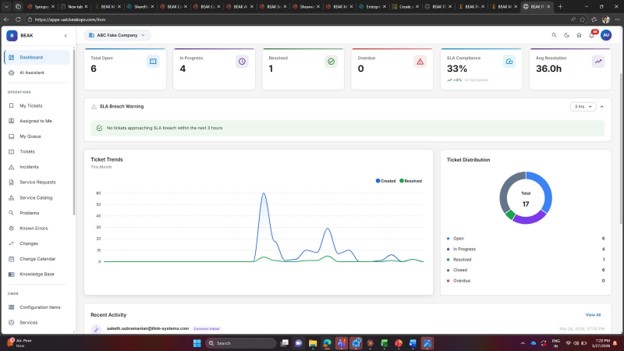
The operations dashboard leads with what matters: open and in-progress volume, resolution trends, and an SLA breach-warning panel that flags tickets approaching breach hours before it happens.
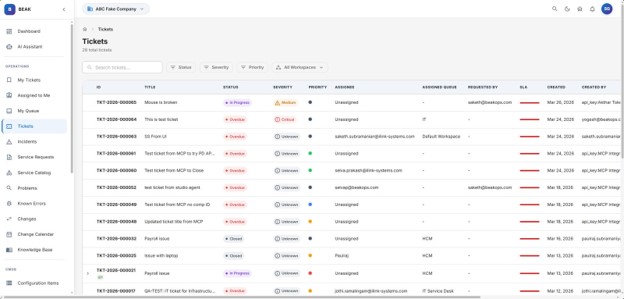
Incidents, service requests, the service catalog, problems, known errors, changes, the change calendar, knowledge base and CMDB — the full practice set lives in one workspace, sharing one data layer.
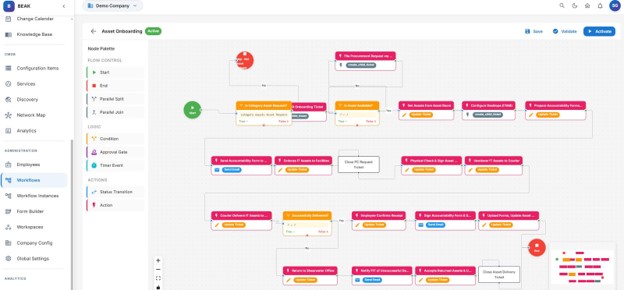
A visual, no-code workflow builder with approval gates, parallel branches, conditions, timers and status transitions — so the processes you actually run become automations, without a development backlog in between.
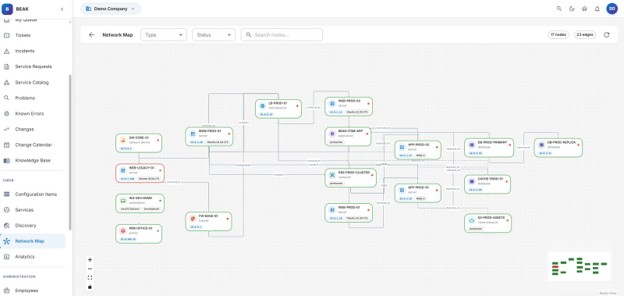
Automated discovery keeps configuration items current and draws the network map for you — so when a change is proposed or an incident lands, impact analysis runs on how the environment actually looks today.
One instance, isolated client environments. Scale from three clients to thirty without re-platforming — each with its own SLAs, catalog and branding.
Client-facing portals carry your brand, not ours. For MSSPs, that is a premium service tier your clients see as yours — because it is.
SaaS-hosted or deployed in your own environment — your compliance posture decides, not our architecture.
No legacy data migration required to start. Discovery, intake, and a working configuration in the first sprint.
Native integrations connect BEAK ITSM to your identity, collaboration, monitoring and existing service management tooling — arrival is additive, not rip-and-replace.
Benchmarks observed across BEAK ITSM deployments, measured 90 days after go-live in typical MSSP environments. VERIFY — pending sign-off All figures below require account-owner and legal sign-off before publish.
| Metric | Before | After BEAK |
|---|---|---|
| Mean time to resolve (MTTR) | 6.1 hrs | 3.4 hrs |
| Tier 1 tickets automated | < 5% | ~58% |
| SLA compliance | 74–78% | 93–96% |
| Tickets per analyst per day | ~48 | ~21 |
| New agent onboarding time | 3–4 weeks | < 1 week |
Figures represent averages across BEAK ITSM deployments of equivalent scope. Individual results vary by environment complexity.
Bring a ticket dump and your sharpest SLA pain. We will show you exactly what the AI engine would have routed, resolved and escalated — in your environment, not a demo script.